Purpose of this blog: Due to the severity of Alzheimer’s disease in the healthcare world today, this type of dementia makes it harder for people to do daily tasks, while at the same time affects those involved with the disease. If you, a client, or a loved one is battling with Alzheimer’s disease, please know that you are not alone. This blog is designed to tie in the recurring issues that you may be dealing with when battling AD with ways that you can manage them.
What is Alzheimer’s, Disease? How Has it Impacted Both the Caregiver and Patient Community?
Alzheimer’s Disease is a cognitive disease that greatly affects how people live. In fact, one third of the elderly population that is 65 years old or older has it. That is a significant amount of people. If you have the disease, or you know someone who may have it; know that there are well-researched steps to take to cope with its challenges.
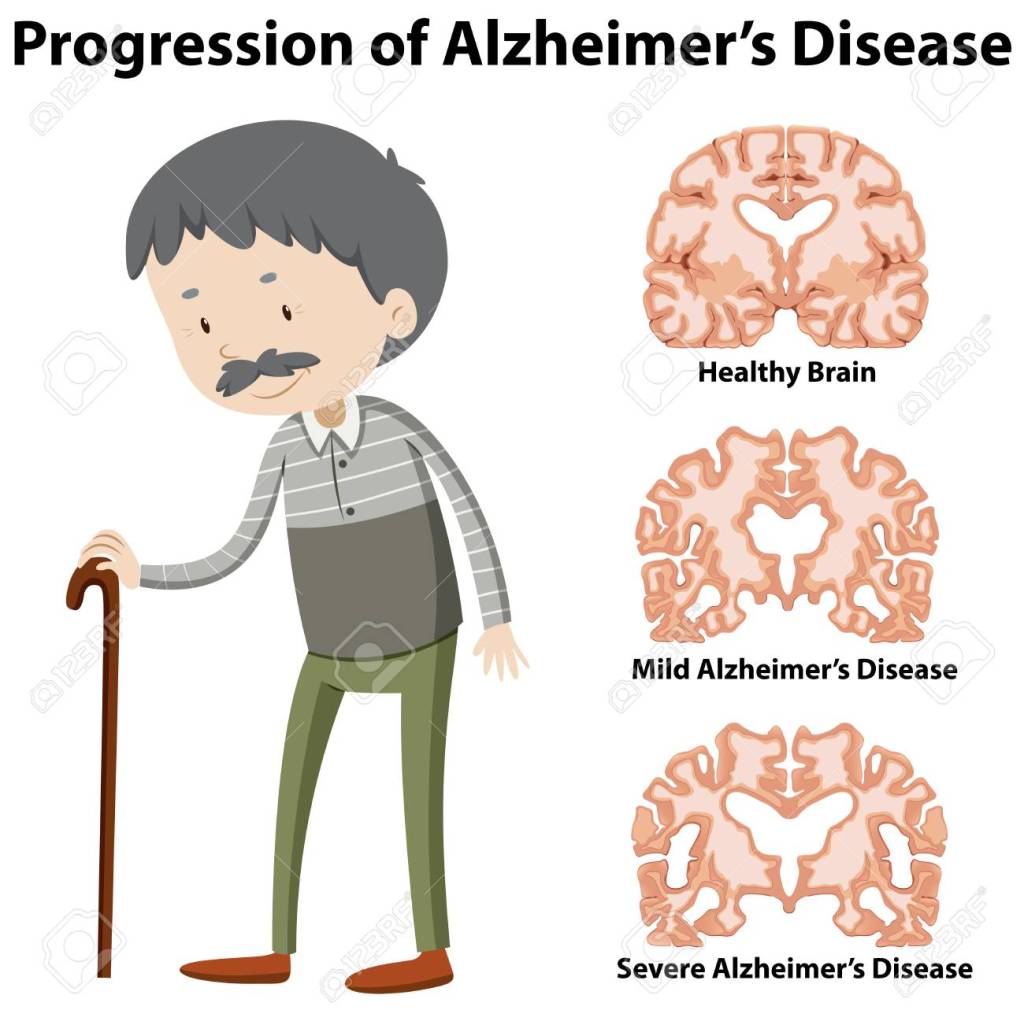
Figure 1: This is a progression of Alzheimer’s disease illustration. Notice the differences between a healthy brain, to a brain that is affected by Alzheimer’s Disease. This just shows one reason of why the disease is so severe. Image by: https://depositphotos.com/200265482/stock-illustration-progression-alzheimer-disease-illustration.html
You may be aware that Alzheimer’s disease is generally a sophisticated disease. You may have concluded after all your numerous doctors appointments, all in which result in little to no answers for a cure. Keep in mind that modern-day medicine struggles to cure Alzheimer’s disease.
Throughout medical history, research has shown that Alzheimer’s disease destroys the inner workings of the brain. This is very hard to tackle. However, the disease itself has sparked a significant amount of hardships to the Caregiving community, which you and/or a loved one may be a part of. The Caregiving Community, composed of family members, and at-home nurses, have a better perspective of how the disease affects patients. You, as a caregiver, play an important role in science. The interaction between caregivers and patients is crucial for scientists to understand the disease more, and brings together the instability that derives from Alzheimer’s Disease.
Nurse practitioner, and clinical journalist, Valerie T. Cotter MSN, CRNP, and FAANP, has dedicated an article, “Alzheimer’s Disease: Issues and Challenges in Primary Care,” to explaining the hardships care givers endure when caring for patients with Alzheimer’s. You may have experienced how healthcare providers fail to routinely check patients for the disease because of insufficient time, inadequate funds, and uncertainty for an early diagnosis. In her article, Cotter mentions common occurrences within diagnosis processes, as providers fear the burden of mistaking the earliest symptoms for another illness, and not knowing the diagnosis enough. Because, the disease makes it significantly challenging for patients to communicate their symptoms, as you have noticed, symptoms become incomprehensible. The wait for diagnosis, then makes it harder for you to plan for the future. As a result of this, you may feel frustrated, I know I would be. Know that this feeling is normal.
Cotter reiterates more about the mental, toll it takes on caregivers, whether it is family members or a hired, at- home nurse. In fact, “the caregiver, often a daughter or daughter-in-law, has a critical role in maintaining the patient’s overall quality of life and is at risk themselves for psychiatric and physical morbidity from the stresses of caregiving [10].
Researchers have taken this occurrence and looked to see the significance of this issue within the Neuroscience community. In fact, a “ survey by the Associated Press and the NORC Center for Public Affairs Research also found that 33% of caregivers struggle to maintain their own health and have skipped personal doctor visits because of caregiving duties.” Because the responsibilities of caring for a patient with Alzheimer’s becomes overbearing for them, caregivers forget to take care of their needs. Or, in some cases they do not even find the time to fit their needs as the patient requires that time. Studies have shown that this is problematic, given that 34% of dementia caregivers are 65 or older.
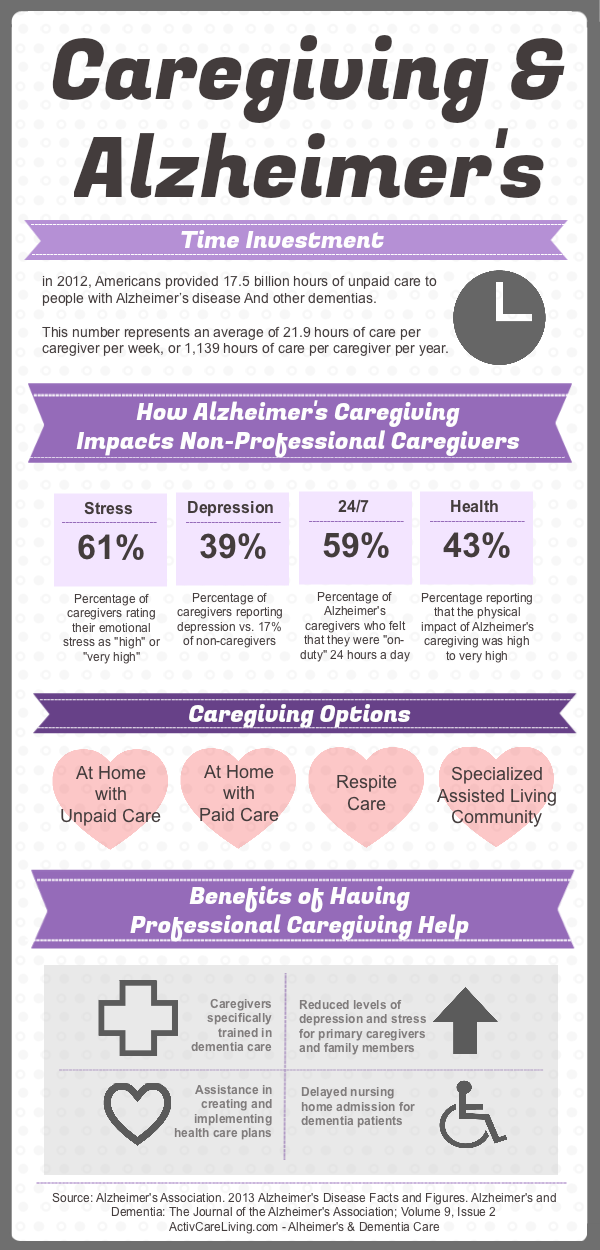
Alissa Sauer, an author and Communications scholar, writes numerous articles about Alzheimer’s research and senior living, as she has described the recurring issues with caregivers in her blog, “The Significant Stress Placed on Dementia Caregivers.” Caring for someone with a severe form of dementia comes with many challenges, as the patient loses the ability to care for their own wellbeing. This may cause the patient to become frustrated. Elena Fazio, a health scientist administrator at the National Institute on Aging sees the effects on caregivers, on a day to day basis. Fazio adds that, “there’s not an opportunity for respite. [People with dementia] have a host of behavioral symptoms that make it more complicated.” As the disease destroys a person’s ability to control their self, leading them to harm’s way without proper guidance. Caregivers have to worry about the mental and physical safety of their loved one, or client. As a result, the nature of the disease influences anxiety and depression.
Alzheimer’s and Financial Instability
Sauer has written two blogs that emphasize the fiscal effects of Alzheimer’s disease on both the healthcare industry and the families. One of them, titled, “Alzheimer’s Awareness Affects Families and Finances. “One of the studies presented by this blog was held by the University of Utah. It found that, “caring for a parent or senior loved one with Alzheimer’s can cost a family an average of $56,290 annually.” And most of the time, these families are below the income range that is able to secure the expenses for hospital visits, medications, and other needs. As a result, the disease, causes people to either delay retirement, and/or cut back on spending.
Recently, a survey interviewed over 3,500 people, 500 of whom either took care of a loved one with AD, or financially supported their loved one toward medical expenses. The survey found that: Nearly 50% of caregivers cut back on spending, 20% went to the doctor less often, 11% of caregivers failed to get their own medications, 11% cut back on children’s educational expenses. The financial toll that the disease brings to families has caused instability for children as families have to cut out educational needs. While at the same time, the wellbeing of the family goes downhill as finances become an issue.
In Sauer’s other blog, “Alzheimer’s Care and Medicare: What You Need to Know,” the author talks about the issues with insurance companies that have influenced the instability for patients and families. In fact, the CEO and Founder of Pathfinders Medical, a patient advocacy group, says that around the clock care for AD patients is usually not considered “medically necessary.” As a result, Medicare refuses to cover the costs for care. In other words, it stands for the cleaning, dressing, eating and living needs that are met by either a loved one or a nurse. A common phrase that Medicare calls it, “custodial care,” means that this kind of care is non-medical.
Common Steps Taken to Alleviate the Issue
You as a caregiver must know that detecting early-stage, Alzheimer’s disease, despite the challenges, can end up being worth while. Finding the disease when it starts to show would prompt you to get periodic screening, which can save costs on care and give enough time to plan your finances. Plus, you want to do what is best for someone who means so much to you.
In terms of mental health, emotional-awareness and mindfulness training can lighten caregiver stress. Know that there are tools like, stress management trainingand even counseling to better cope with the hardships you may be facing. This can reduce depression and ensure mental stability.
When looking at the fine details of finances, the battles between care needed and care covered can cause both financial trouble and lots of stress. You should understand long-term care insurance, Medicare, and how they both work. Being more educated about these companies can give you options on choosing the help you need to cover some of the costs of care. If you or your client is low income, know that Medicaid is a good option. Learn more about Medicaid at: https://www.medicaid.gov. Taking these necessary steps will help you be better prepared when dealing with the mental and fiscal costs of care. Because, the job of caregiving does not just hold the liability of caring for your patient; you have the responsibility to care for yourself.
 Issues arising with Alzheimer's